
Fairplay Guide
Fairplay Blackjack: Rules, Hand Values and Variations
Read Fairplay Blackjack: Rules, Hand Values and Variations, with clear explanations of the format, variations and the meaning of its rules.
Fairplay Blackjack is a practical guide to blackjack’s structure, card values, and round-by-round decisions. Each player plays against the dealer rather than other players. The aim is to finish closer to 21 without exceeding 21, while recognising that rules differ between tables and jurisdictions. This page explains the rules.
What blackjack is
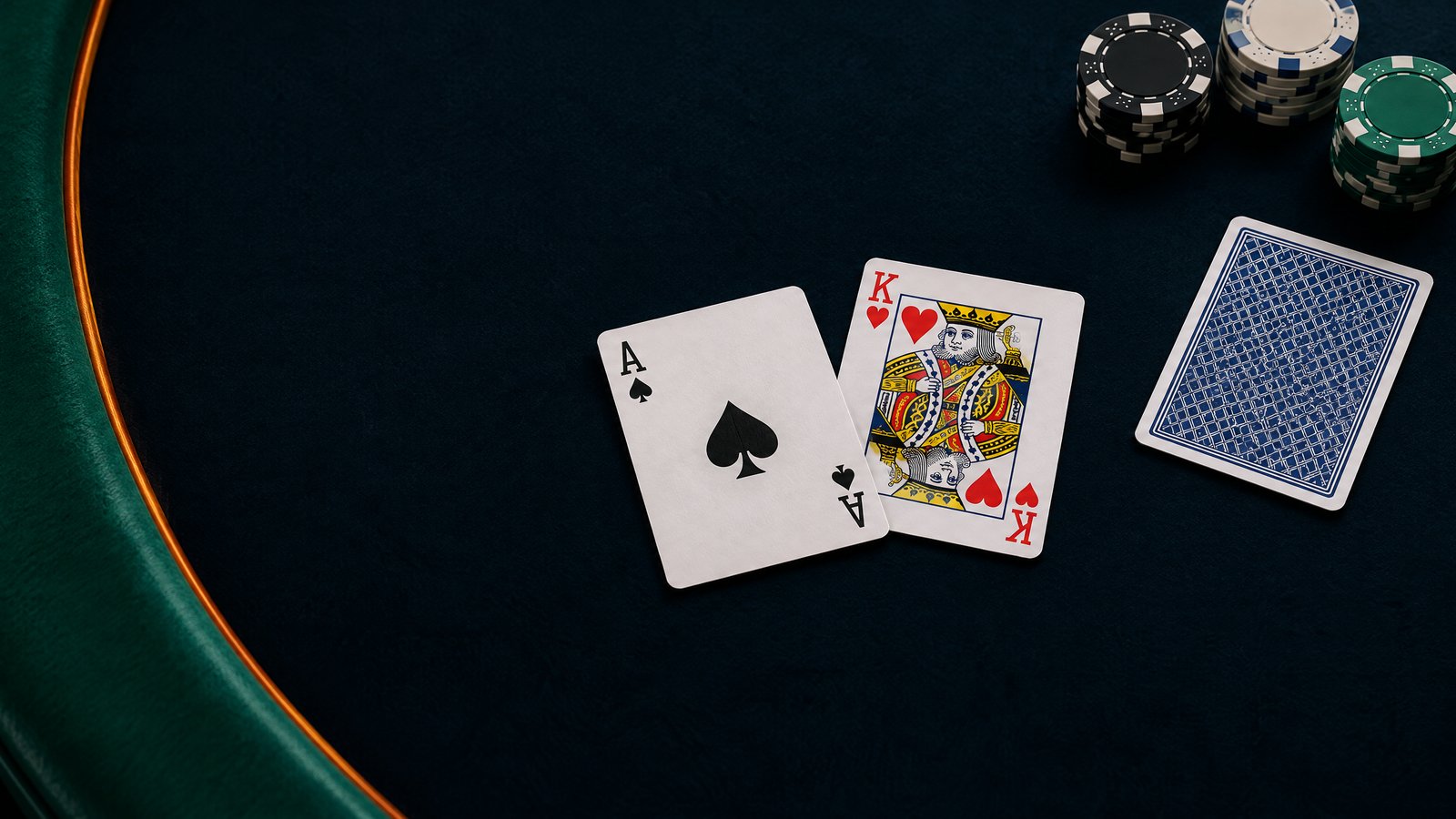
A standard pack contains 52 cards without jokers, although casino-style games commonly combine several packs in a shoe. A regulatory rules document from Washington State permits up to eight decks and notes that suits have no scoring value [1]. Number cards retain pip value; jacks, queens and kings count as 10; an ace counts as 1 or 11, whichever avoids a bust. A hand using an ace as 11 is “soft”; one in which it must count as 1, or which has no ace, is “hard.”
The opening deal normally gives each player two cards and gives the dealer one visible card plus one concealed hole card. The dealer’s visible card is often called the upcard. A two-card ace plus any 10-value card is a natural blackjack, which is different from an ordinary hand that reaches 21 with three or more cards. The exact settlement for a natural is a table rule; a commonly published example is 3:2, while some rule sets specify even-money settlement. Read the rules rather than assuming [1][2].
How a round proceeds
The initial deal and dealer check
After the first cards are dealt, a dealer may check the hole card when the upcard is an ace or a 10-value card, depending on the rules. If the dealer has a natural, the round may end immediately. A player natural and a dealer natural generally result in a push, meaning neither side wins the main hand. A player natural against a non-natural dealer hand is normally treated separately from a regular 21.
Player choices
When no early settlement ends the round, players act in turn. The main choices are:
- Hit: take another card, adding its value to the hand.
- Stand: take no further card and keep the current total.
- Double down: add a second stake equal to the original and take one final card, then stand. Limits on which starting hands may double vary.
- Split: divide a starting pair into two hands by adding a second equal stake. Each new hand receives cards and is completed under the table’s split rules.
- Surrender: where offered, abandon the hand after the first two cards and forfeit a specified portion of the original stake. This is not universal.
A hand above 21 busts and loses the main hand. Standing below 21 does not protect against a higher dealer total. Insurance is a separate side wager offered when the dealer shows an ace; the Washington rules describe it as up to half the opening wager and payable 2:1 if the hidden card makes a dealer natural [1]. It is separate from the main hand.
The dealer’s procedure and settlement
After all surviving players have stood or busted, the dealer exposes the hole card and follows a fixed drawing rule rather than choosing freely. A common rule is to draw below 17 and stand on hard 17 through 20. Some tables require a hit on soft 17, while others stand; that variation changes the mathematical profile of the game [1]. If the dealer busts, every player who has not already busted wins the main hand. Otherwise, a higher total wins, an equal total is a push, and a lower total loses. Published payouts for a regular win are often even money, but natural-blackjack payouts, split-hand treatment, and doubling settlement must be checked in the stated rules [1][2].
Worked hand examples
Hypothetical example — hard and soft totals: A player receives 10 and 6, a hard 16. Taking a 7 produces 23, so the hand busts. In another hypothetical, a player has ace and 6: the ace counts as 11, making soft 17. If the next card is a 9, counting the ace as 1 changes the total to 16 rather than 26; the hand remains live at hard 16. This flexibility is why an ace cannot be assigned one permanent value at the start of every hand.
Hypothetical arithmetic check: A player holds 8 and 3, then hits a 6. The total is 8 + 3 + 6 = 17. If the dealer finishes on 18 without busting, the player loses; if the dealer finishes on 16, the player wins; if both finish on 17, the result is a push. These outcomes follow comparison, not the order in which cards look stronger.
Blackjack variations and what changes
The word “blackjack” covers several rule configurations. Single-, double- and multi-deck games alter the pack composition and dealing method. Dealer soft-17 treatment changes when the dealer stops. Natural payouts can be 3:2, 6:5, or another published amount, so a natural should not be confused with an ordinary 21. Rules may also limit re-splitting, restrict doubling, apply special treatment to split aces, or omit surrender altogether. Insurance and side wagers introduce a separate settlement layer and should be identified as such.
Electronic and live-dealt formats may present the same scoring system but differ in display, timing, card delivery, or rule-sheet wording. Those differences do not establish fairness, licensing, availability, or an operator relationship. For comparison, record deck count, dealer soft-17 rule, natural payout, split restrictions, double-down limits, surrender availability, and side wagers.
Common questions
Is 21 always a blackjack?
No. A natural blackjack is specifically an ace and a 10-value card as the first two cards. A hand reaching 21 after a hit, or a 21 formed after splitting under many rule sets, is ordinarily a regular 21 and may receive a different settlement [1].
What is a push?
A push is a tie on the main hand: the player and dealer have the same qualifying total, so the original main stake is returned under the cited rules. A natural-versus-natural result is commonly a push as well.
Why do rule sheets matter?
Small details have measurable consequences. A table that hits soft 17, pays a different natural amount, or restricts re-splitting is not the same ruleset as one that does the opposite. The label Fairplay Blackjack identifies the subject of this guide; it does not verify an operator, licence, affiliation, or current availability.
What is the India legal context?
The Government of India’s PIB explainer says the PROG Act, 2025 and Rules, 2026 prohibit online money games, including games based on chance, skill, or both, and also prohibit related advertising, promotion, facilitation, and connected payment processing; the Rules commenced on 1 May 2026 [4]. This page is therefore limited to factual game rules and sports comparison, not access, transactions, or promotion.
Sources and fact-checking
- [wsgc-blackjack-rules] Washington State Gambling Commission — Blackjack Game Rules Checked 2026-10-16
- [bicycle-blackjack] Bicycle Cards — Blackjack Checked 2026-10-16
- [pib-online-gaming-governance] Press Information Bureau, Government of India — A New Era of Online Gaming Governance Checked 2026-10-16